Release Notes - Major Version Update
1. Overview
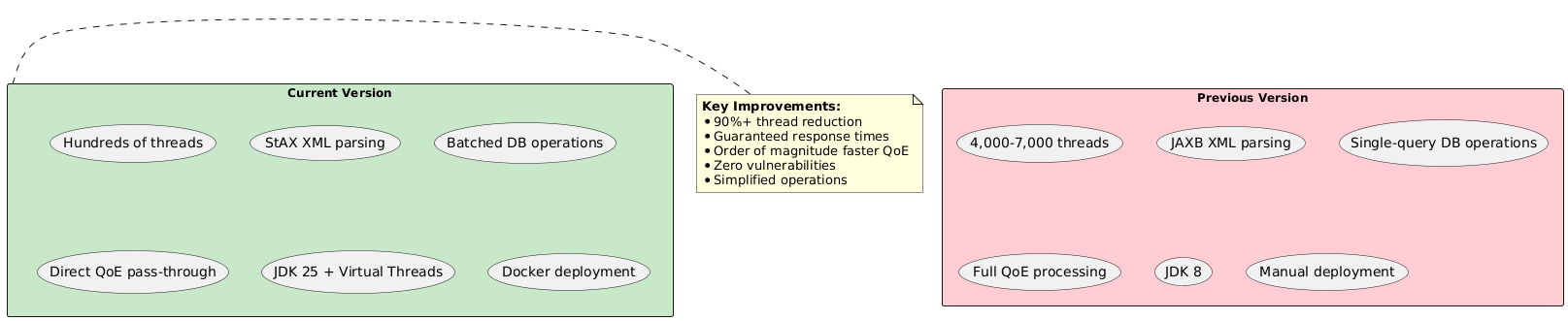
This major release represents a complete platform modernization, delivering significant performance improvements, enhanced security, simplified deployment, and reduced operational complexity.
2. Critical Performance Improvements
2.1. Thread Management Optimization
| Metric | Previous | Current | Impact |
|---|---|---|---|
Total system threads |
4,000-7,000 |
Hundreds |
90%+ reduction in memory footprint and context switching overhead |
Sleeping threads |
High |
Minimal |
Improved resource utilization |
2.2. TR-069 Protocol Performance
Response Time Guarantees:
-
Inform messages: 5 seconds (guaranteed)
-
Other requests: 30 seconds (guaranteed)
Result: Significant reduction in device retry attempts and network traffic.
2.2.1. TR-069 Processing Optimizations
| Component | Change | Benefit |
|---|---|---|
XML Parser |
JAXB → StAX |
Lower memory consumption, faster parsing |
Request Processing |
Thread pool → Virtual threads |
Higher concurrency with lower overhead |
Database Operations |
Individual queries → Batched operations |
Reduced database round-trips |
Caching Strategy |
Enhanced multi-level caching |
Minimized database load |
Task Flow |
Session-level caching |
Eliminated redundant processing within device sessions |
3. Platform Modernization
3.1. Java Runtime
| Component | Previous | Current |
|---|---|---|
JDK Version |
8 |
25 |
Key JDK 25 Features Utilized:
-
Virtual Threads (Project Loom): Enables massive concurrency with minimal resource overhead
-
Improved Garbage Collection: Reduced pause times, better throughput
-
Enhanced Security: Modern cryptographic algorithms, TLS 1.3 support
-
Performance Optimizations: JIT compiler improvements, optimized string handling
-
Pattern Matching & Records: Cleaner, more maintainable code
4. Deployment and Operations
4.1. Deployment Method
| Aspect | Previous | Current |
|---|---|---|
Packaging |
ZIP archive |
Docker container |
Deployment |
Manual installation |
Container orchestration |
Scalability |
Vertical only |
Horizontal scaling ready |
5. Database Performance
6. Architecture Simplification
6.1. Removed Components
The following modules have been removed from the core platform:
-
QoE UI (under consolidation)
-
External integration modules:
-
Azure integration
-
Manas integration
-
Axioma integration
-
Anms integration
-
Other vendor-specific integrations
-
Openfire XMPP server support
-
Rationale:
-
Reduced core platform complexity
-
Improved maintainability
-
Enhanced modularity
Migration Path:
External integrations can be reimplemented as independent microservices when required, providing:
-
Better separation of concerns
-
Independent deployment and scaling
-
Technology flexibility per integration
8. Migration Considerations
9. Upgrade Path
-
Review removed modules - identify required external integrations
-
Prepare Docker environment - container orchestration setup
-
Migrate configuration - consolidate to
app.envformat -
Database backup - full backup before migration
-
Deploy new version - Liquibase handles schema migration automatically
-
Validate functionality - verify protocol endpoints and integrations
-
Performance monitoring - confirm performance improvements
10. Summary
This release delivers:
-
Performance: 90%+ reduction in resource usage, guaranteed response times
-
Security: Modern Java platform, zero vulnerabilities, updated dependencies
-
Operations: Simplified deployment, unified configuration, automated migrations
-
Scalability: Docker-based horizontal scaling, reduced database load
-
Reliability: Improved stability through reduced complexity and better resource management
The modernization represents a foundation for future enhancements while delivering immediate, measurable improvements in performance and operational efficiency.