Knowledge Vault — the shared Obsidian AI/ notes
A shared Obsidian vault is the agents' long-term memory: the root causes of fixed bugs and the design decisions behind shipped features, accumulated across sessions and across the whole team.
It is a git repository — Friendly-Technologies/ft-obsidian-knowledgebase — that each developer clones and opens as an Obsidian vault. The git repo is the source of truth; Obsidian is just the viewer/editor on top of a clone. A note written by one developer’s agent and pushed is knowledge every teammate’s agent reads on the next related task.
|
This is the second, complementary knowledge layer — do not confuse it with the Qdrant Knowledge Base.
|
The graph — hubs, notes, and the index
Notes are not loose dots. Every note branches off its repository hub (a Map of Content), the
hubs branch off the root _Index, and each hub links sideways to that repo’s curated Wiki/.
That connectivity is what makes the vault navigable in Obsidian’s graph view.
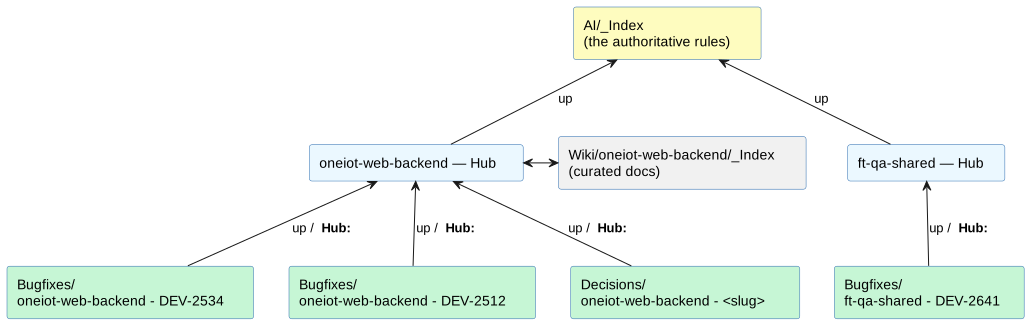
Only [[wikilinks]] (in the body) and link fields in frontmatter create graph edges — tags
and Dataview results do not. A note without a **Hub:** line is an orphan: unfinished work.
|
What’s in it — the AI/ layout
| Path | What it holds |
|---|---|
|
The authoritative contract — the vault’s own rules. The |
|
The repository hub (Map of Content) — the root node every note for that repo branches from. Links up to |
|
Root causes of fixed bugs. One note = one bug (not one per incremental change). Named |
|
Accepted architecture/feature decisions. One note = one decision/feature. ( |
|
Temporary work notes for in-progress MAJOR/CRITICAL work, so a dropped session resumes instead of restarting. Folded into the permanent note and deleted on completion. |
|
Curated per-repo docs (architecture, gotchas, conventions). Read freely; the agents modify it only when the user explicitly asks. |
When the agents touch it — the lifecycle
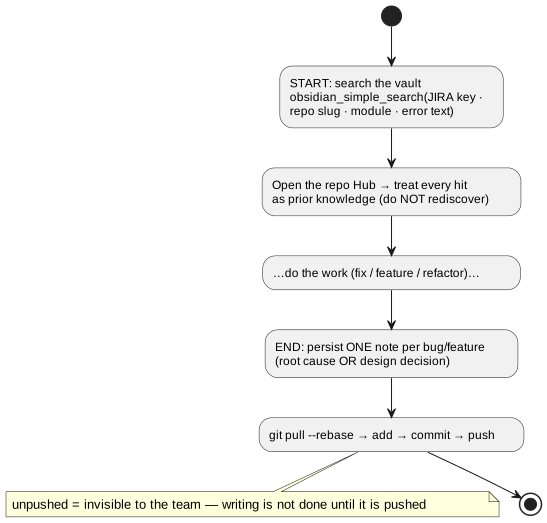
The vault is an explicit step of the FT pipelines (ft-fix, ft-developer, bugfix-agent), not an
optional afterthought. Two touch points bracket every bugfix / feature / refactor:
| Step | What happens |
|---|---|
Read at start |
Search the vault for the JIRA key / repo slug / module / error text and open |
Write at end |
On a terminal outcome, persist one note per bug/feature: a bugfix root cause → |
Commit — the agent owns it |
|
| Never write to the vault secrets, tokens, credentials, or customer/personal data. Notes describe code and root causes, not customer environments — and never a machine-specific vault path. |
The note format contract (non-negotiable)
Every AI/ note follows the same shape — enforced by the obsidian-knowledge-vault skill:
-
English only — frontmatter and prose, every note, no exceptions.
-
YAML frontmatter —
repo(canonical hyphenated slug),type,jira,status,date,up: "[[<repo-slug> — Hub]]",tags. -
Clear
## sections, never a flat list of bold bullets. Bugfix →Symptom/Root cause(with afile:linepath) /Fix/Notes. Decision →Context/Decision/Alternatives/Consequences. -
Hub link, zero orphans — frontmatter
up:and a body**Hub:** [[<repo-slug> — Hub]]line (the body wikilink is what creates the graph edge), then list the note in its hub. -
Canonical hyphenated repo slug everywhere (files, tags, hub) — never the underscore form.
-
Hygiene self-check after every edit — no stray files, no broken links, no orphans, no phantom placeholder links.
Templates live in the vault’s templates/ folder (bugfix.md, decision.md, hub.md,
checkpoint.md) — excluded from the graph so their placeholder links never become phantom nodes.
|
How the agents reach it — and how to set it up
Two access routes, neither hardcodes a vault path (the machine’s own config resolves wherever the clone lives):
| Route | Used for |
|---|---|
|
HTTP to the local Obsidian REST API — search, read, write notes. Resolves to whatever vault Obsidian has open. |
|
git commits and a direct-write fallback when Obsidian is closed. Set per machine at install time. |
Degrades gracefully: MCP reachable → normal; Obsidian closed but $FT_VAULT_PATH set → write the
note directly and commit; neither → the task is not blocked, the agent reports "no knowledge
persistence this run" and includes the note body for the user to paste in.
Setup is part of install.sh / install.ps1 — the mcp-obsidian server, $FT_VAULT_PATH, and
a gh auth check so the agent’s push works unattended. The obsidian plugin itself is the one
row the installer can never turn green: no marketplace source is configured for it, so
verification reports it missing and you pick it manually — inside Claude Code open /plugin and
select obsidian from the marketplace browser. Step-by-step: Deployment &
Usage § Plugins / MCP servers.
| Next → Knowledge Base (the read-only Qdrant layer) · Claude Toolkit (who runs whom) · Deployment & Usage (install it). |