Device Resolution
This is the page a developer reads to understand how a fleet comes into being.
A campaign’s device set starts as a selection — conditions over the ACS catalog, a list of serials pasted into a form, or an uploaded file — and ends as rows in fcc_test_device that are never refreshed again.
Everything between those two points is in this page.
The HTTP surface is on POST /FCC/devices/resolve and POST /FCC/devices/count; what the resulting rows hold is on fcc_test_device.
One Path, Four Callers
FccDeviceResolveService is the whole of it, and it is the only implementation.
| Caller | What it asks for |
|---|---|
|
The fleet, one page of it, and every counter. |
|
The same, without the page. |
|
The same as |
|
The same again, through |
That is not tidiness. The count is what the wizard shows while the operator is still choosing, and the save is what it stores — the two disagreeing would mean an operator storing a fleet other than the one they were shown, and both would be internally consistent about it. Every counter, every refusal, the selection limit and both serial reports are therefore computed by the same code.
PUT /FCC/item/details with an explicit devices list takes a different entry point — FccTestValidator.resolveDevices — but lands in the same DAO (FtacsDeviceResolveDao) with a cpe.id IN (…) predicate instead of a condition. FtacsDeviceResolveDao is the only reader of ftacs.cpe in this service, and that is deliberate for the same reason: a second, narrower reader is how the fleet an operator was shown and the fleet that was stored come to be assembled by different sets of predicates.
The ACS Schema This Service Reads
Four tables, a read-only account, and no write of any kind.
ftacs is not owned or migrated from here (Schema Ownership); the columns below are a contract this service depends on and checks at startup (ftacs Read-Only Schema Check).
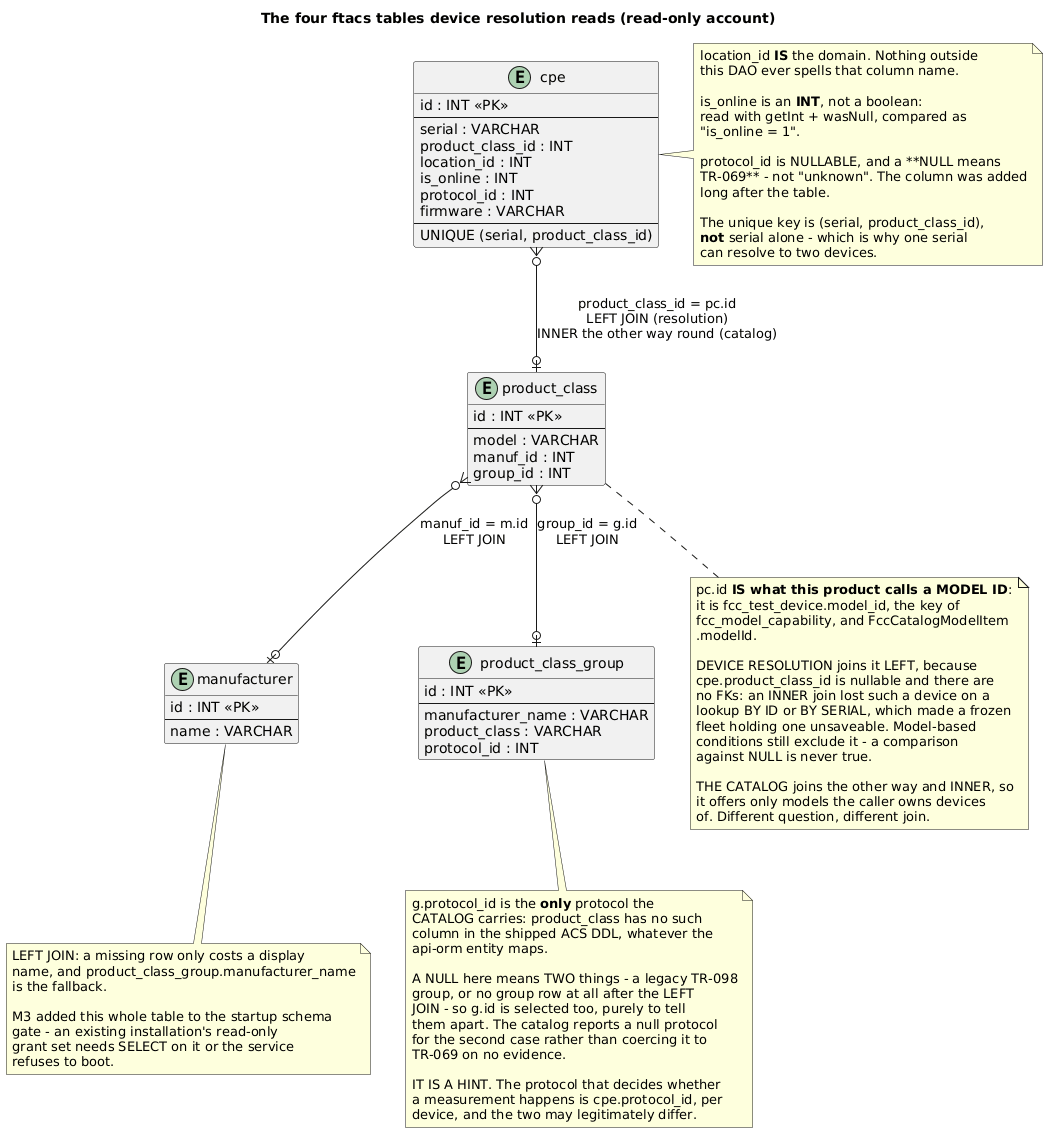
cpe
| Column | What this service depends on |
|---|---|
|
The id the ACS addresses a device by in |
|
The id the ACS identifies a measurement by, and mandatory on the wire — see A Device Without a Serial Is Refused — Twice. |
|
The model id. See product_class. |
|
|
|
An |
|
Nullable, and a null means TR-069 — not "unknown". The column was added long after the table, and a legacy CWMP device still carries a null. |
|
A condition field, and part of |
|
The unique key is One serial legitimately exists on two product classes — a re-badged unit, a model split, an import that created a second product class for the same hardware — and both rows are real CPEs the ACS can address and measure separately. That single schema fact is why |
product_class
product_class.id is what this product calls a model id, and the name is worth stating plainly because three different things key off it:
-
fcc_test_device.model_id— the frozen per-device model of a fleet; -
fcc_model_capability.model_id— the connection ceilings (fcc_model_capability); -
FccCatalogModelItem.modelId— what the wizard offers and what acondition.modelIdsnames.
Columns read: id, model, manuf_id, group_id.
Every join of the resolution read is LEFT, product_class included.
cpe.product_class_id is nullable and the ACS schema has no foreign keys, so a device with no product class — or with a dangling one — simply did not come back from an INNER join. That cost nothing on a model-based selection and everything on the other two:
-
a lookup by cpe id or by serial silently lost the device;
-
FccTestValidator.resolveDevicesthen reported it as an unknown or out-of-scope id; -
and because the UI re-submits the whole stored fleet on every save, a frozen fleet containing one such device could no longer be saved at all — not even for a rename — while
validateDeviceSetEditableforbids dropping it. That is the same trapvalidateAddedDeviceSerialswas written to avoid for a cleared serial (A Device Without a Serial Is Refused — Twice).
The selection semantics are unchanged. A device with no product class cannot match pc.id IN (…), pc.manuf_id IN (…), pc.group_id IN (…) or pc.model IN (…) — a comparison against NULL is never true — so every model-based condition still excludes it, exactly as an INNER join did. What changed is that a lookup by id or serial now finds it, with a null modelId, model and manufacturer, which every consumer of these rows already tolerates: fcc_test_device.model_id is nullable, validateConnectionCeilings filters the nulls out before asking for capabilities, and countsByModel gives it a bucket of its own (see A Device With No Product Class Is Still a Device).
The CPE-level conditions now reach it too, and that is the one thing the change genuinely widens. c.firmware, c.serial, c.is_online, c.protocol_id and c.location_id are columns of the device: a selection made only of those never said anything about a product class, and excluding a class-less device from it was an artefact of the join rather than a rule anybody wrote. Such a device is a real CPE, in the caller’s own domain, that the ACS can be asked to measure.
The manufacturer and product_class_group joins were always LEFT: a missing row there costs only a display name.
The catalog’s join to cpe is INNER, and that one stays. FtacsCatalogDao.findModelsWithDevices joins product_class to cpe, so the catalog offers only models the caller actually has devices for: product_class holds every model the installation has ever seen, and listing all of them would fill step 1 of the wizard with hundreds of entries that can never yield a fleet. This is a different question from the one above — there the subject is a device and the product class is an attribute of it; here the subject is a model and a model with no devices is genuinely not on offer.
The one read that deliberately does not join cpe is findModelNames, which resolves the names of a capability admin page — a capability row is perfectly legitimate for a model the installation currently has no units of, because a capability is a property of the hardware and is entered before the first unit ships.
manufacturer
Columns read: id, name. LEFT-joined via product_class.manuf_id.
The display name falls back to product_class_group.manufacturer_name when manufacturer.name is missing, and the fallback is applied in the row mapper, not as a COALESCE in the statement: a coalesced expression would have to be repeated in the catalog’s GROUP BY, which is where the two vendors disagree most, and the fallback is a display decision anyway.
The fallback is repeated inside the predicate when the caller filters by manufacturer name:
(UPPER(m.name) IN (:manufacturerNames)
 OR (m.name IS NULL AND UPPER(g.manufacturer_name) IN (:manufacturerNames)))
Without the second arm, filtering by a name the catalog itself displayed would miss exactly the devices whose name came from the fallback.
|
M3 added this table to the startup schema gate. An installation upgrading from M2 must extend its read-only |
product_class_group
Columns read: id, manufacturer_name, protocol_id. (FtacsSchemaCheckRunner’s required-column list also names `product_class_group.product_class, but no statement in FtacsCatalogDao selects it — SQL_SELECT_MODELS reads only g.id, g.manufacturer_name and g.protocol_id off this table. That fourth entry looks like a surplus the M4 trim of the resolution read missed, and is worth removing from the startup gate rather than treated as a column this service depends on.)
g.protocol_id is the only place the catalog carries a protocol: product_class has no such column in the shipped ACS DDL, whatever the api-orm entity maps.
|
A null The join is LEFT, so the column comes back null both for a legacy TR-098 group — a real fact about a real group, which
|
|
The catalog protocol is a hint, not the authority. It is a property of the model’s group. The protocol that decides whether a device can actually be measured is The two can legitimately disagree — a device of a TR-098 group re-registering with a TR-181 data model is an ordinary upgrade — and when they do, the per-device value is the one that decides whether a measurement happens. This field belongs in the catalog the operator browses and never in a decision about a run. |
The Three Source Types and the Closed Condition Set
FccDeviceSourceTypeEnum decides which half of the request is read, and there is no default: guessing it from whichever field happens to be filled in is how a request that meant "these 12 serials" becomes a request for the whole installation.
sourceType |
What is read |
|---|---|
|
The |
|
|
|
The serials parsed from the uploaded part. Same rules as |
The Condition Set Is Closed and Typed
FccDeviceConditionRequest and FtacsDeviceFilter are records with named fields, not a map, not a list of (column, operator, value) triples, and above all not a predicate string.
Everything in them arrives over an HTTP body from ui-backend, and this service has no authentication of its own (No Authentication by Design).
A condition the caller can spell freely is a query this service never intended to run.
Adding a condition therefore means adding a field to the record and a predicate in FtacsDeviceResolveDao — there is no passthrough, and there is no way to add one by accident.
Every field is optional and means "not filtered" when null or empty.
Present fields combine with AND; no two different fields are ever OR-ed.
| Field | Type | SQL | Notes |
|---|---|---|---|
|
|
|
|
|
|
|
Trimmed, upper-cased and de-duplicated in the DAO, next to the |
|
|
|
The id form the catalog offers. |
|
|
|
Exact, and not upper-cased — unlike |
|
|
|
|
|
|
|
Exact. |
|
|
|
|
|
String |
|
Wildcards in the value are escaped — it is a substring the operator pasted, not a pattern they write. See The LIKE Escape Character Is |
|
Boolean |
|
|
|
|
|
Narrows within the caller’s scope only — The Empty Intersection Selects Nothing. |
Two fields of FtacsDeviceFilter never come from a condition block: serials (from the two serial source types) and cpeIds (from the explicit-list save path). No caller ever sets both — see IN Lists Are Chunked at 1000, and Only One of Them Per Call.
A List of Nulls Is Refused, Not Quietly Emptied
FccDeviceFilterSanitizer.sanitized strips the nulls and blanks out of every caller-supplied list before any of them becomes a predicate, and then refuses a list that had entries and has none left.
Both halves matter, and they fail in opposite directions.
Stripping. A null inside an IN list is not ignored by SQL. It emits pc.id IN (123, NULL), and pc.id IN (NULL) is a perfectly legal term that is never true — so {"modelIds": [null]} narrowed the whole selection to zero devices with no error whatsoever, and the operator was shown an empty fleet for conditions they believed were right.
Refusing what is left. Silently dropping a condition that stripped to nothing would widen the selection: the caller asked to narrow by model and would get every model instead. Widening is the one direction this code must never fail in — the mistake is invisible, it is saved as a frozen fleet, and the campaign then measures subscribers nobody chose. The 400 says so:
condition.modelIds holds 3 entries and every one of them is empty; send the
values you mean to narrow by, or omit the field entirely, which is what
selects every value
condition.protocols gets the same treatment one level up, in FccDeviceResolveService.protocolIds: blank entries are dropped — a form that posts an empty row is the normal shape of an FT UI request — but a list left with nothing is refused rather than turned into "every protocol".
It has to happen a step earlier there, because the names must be parsed before anything can tell whether a list has anything left in it.
|
The rule lives at the service boundary, in a component of its own, and no longer in the DAO. It was written in One component, because — at the time this rule was written — there were two filter builders and the rule had to hold for both.
|
|
Since M4 there is a third filter builder, and it does NOT run the sanitizer — the one live exception to the rule above.
It is harmless today, and the reason is specific rather than structural. The serials it builds the filter from come from That is exactly why it must not be read as a second, safe way to skip the sanitizer: the safety is a property of this caller’s upstream data, not of the DAO, which — as stated above — refuses nothing and validates nothing and will turn whatever list it is handed straight into a predicate. A future change to |
|
It is not caller-supplied: it comes from |
|
It is defensible — a model string is offered to the caller by the catalog and comes back verbatim, whereas a manufacturer name is the field an operator pastes from a saved filter — but it is not stated anywhere in the code, and a caller who hand-types |
The SQL Rules That Are Load-Bearing
FtacsDeviceResolveDao is written under four constraints that are decisions, not omissions, and each of them has a failure mode attached.
Before any of them, one property of the class as a whole: it refuses nothing and validates nothing.
The filter is expected to arrive already sanitized from whichever builder made it (A List of Nulls Is Refused, Not Quietly Emptied), so the DAO never decides that a selection is malformed and never names an HTTP status.
That is what lets every method here trust its argument uniformly — and it is why a new caller must run FccDeviceFilterSanitizer rather than assume the DAO will catch a bad list, because it will not: it will turn it into a predicate. That expectation is not currently enforced on every path that reaches this DAO — FccLegacyFleetSnapshotService.filterBySerials is a live exception, see A List of Nulls Is Refused, Not Quietly Emptied, and is safe today only because of a property of its own upstream data rather than because anything here would catch it if that stopped being true.
No Vendor-Specific SQL, and No Paging in SQL
One statement text, exercised by every installation.
There is no LIMIT, no FETCH FIRST, no ROWNUM and no OFFSET anywhere in this DAO.
The two vendors spell row limiting differently, so a paged statement would be two statement texts — of which only the one the developer’s machine runs is ever exercised, and the other is discovered at a customer site.
What bounds the read instead is the fleet limit:
count(filter)                      -- one statement, no rows read
  > ft.fcc.max-devices-per-test ?  -- 400, nothing further happens
find(filter)                       -- the WHOLE match, ORDER BY c.id
  -> page sliced in memory, counters derived from the same rows
The full set is therefore small enough to hold (at most 20 000 rows by construction), one read serves both the page the operator is looking at and the totals printed above it, and the page is a subList.
Deriving the counters from the rows in hand rather than from further aggregate queries is also what keeps them consistent with one another: a device that goes online between two statements cannot make the sum of the per-model counts disagree with the total.
ORDER BY c.id is not decoration. A deterministic order is what makes slicing the page in memory reproducible between two calls — an unordered read may repeat a device on page two and drop another.
|
There is exactly one path where the limit cannot be counted first, and it is branched on explicitly rather than paid for silently. When the caller is visible in more domains than one
The read it comes after is still bounded by the caller’s visible domains, so this is not an unbounded read.
The alternative — a |
IN Lists Are Chunked at 1000, and Only One of Them Per Call
Oracle refuses more than FccDbConstants.IN_CLAUSE_MAX_EXPRESSIONS (1000) expressions in a single IN list. MySQL has no such limit, but the same code has to run on both.
Three lists reaching this DAO can exceed it, and they are handled differently on purpose:
| List | Treatment |
|---|---|
|
Chunked into several statements. It is caller-sized — it can legitimately hold the whole fleet. |
|
Chunked, same reason. It is the save path’s list of already-resolved devices. |
|
Not chunked at all. See The Domain Predicate Goes In Memory Above 1000 Visible Domains. |
Only one of the two caller-sized lists is chunked per call, and that is the point of FtacsDeviceResolveDao.chunks: a request carries either a serial list or an id list, never both — the wizard selects by conditions or by serials, and the save path selects by the ids the wizard already resolved — and chunking both would produce a statement per pair rather than per chunk.
Should a filter ever arrive with both, the serials are chunked and the ids ride along whole in every chunk: narrower than dropping a predicate, which is the one outcome that would silently widen a selection.
An unfiltered read is a single empty chunk, so that every method here is one loop and "no list given" is not a second code path.
Both lists reach the DAO de-duplicated — FccSerialListParser for the serials, a LinkedHashSet for the ids — so a device matches exactly one chunk and a summed count cannot count it twice.
When more than one chunk ran, the merged rows are re-sorted in Java, because ORDER BY only orders within one statement and the page is sliced from the merged list.
The condition lists are refused rather than chunked, at 1000 entries (FccDeviceResolveService.validateCondition): a condition list is sized by the catalog the caller picked from, so an oversized one is a malformed request and not a fleet — see the refusal table in POST /FCC/devices/resolve.
The Domain Predicate Goes In Memory Above 1000 Visible Domains
| Visible domains | Where the predicate is applied |
|---|---|
None (scope |
Nowhere. No domain predicate at all. |
1..1000 |
In SQL: |
More than 1000 |
In memory, on the rows that come back: |
The domain list is not chunked because it combines with whichever caller-sized list is present — chunking it as well would multiply the two chunk counts. Applying it in memory stays cheap precisely because the row set is bounded by the fleet limit and not by the domain count, so a cross product of statements would buy nothing.
A row with a null location_id is dropped by the in-memory arm, matching what the SQL arm does with it.
The catalog read solves the same problem differently, and correctly: FtacsCatalogDao.findModelsWithDevices reads one chunk of domains at a time and sums the partial rows per modelId in memory. Summing is exactly right there and not an approximation — a cpe row carries one location_id, so the chunks partition the device set and no device can be counted by two of them.
The LIKE Escape Character Is !, Not a Backslash
Every other LIKE in this service uses a backslash. This one cannot.
ESCAPE '\'   -- MySQL: unterminated literal; MySQL needs '\\'
ESCAPE '\\'  -- Oracle: ORA-01425, escape character must be
             --         a character string of length 1
There is no spelling of a backslash escape that both vendors accept, and this DAO is built around having one statement text for both. A character with no meaning in either dialect’s literal syntax gives that, so the statement is:
c.serial LIKE :serialPattern ESCAPE '!'and FtacsDeviceResolveDao.escapeLike escapes ! first, then % and , into !!, !% and !.
Escaping is the case that actually bites. Serials contain underscores, and an unescaped is a single-character wildcard on both vendors — so a search box containing AB_12 would quietly match every serial of the same length with AB and 12 in those positions, instead of the one device the operator pasted. The operator would see a plausible-looking list of the wrong devices.
The protocol_id IS NULL Arm Is Not Optional
When TR069 is among the requested protocols, the predicate gains a second arm:
(c.protocol_id IN (:protocolIds) OR c.protocol_id IS NULL)cpe.protocol_id was added long after the table, and a legacy CWMP device still carries NULL there.
FccCpeProtocolEnum.fromProtocolId(null) reads that null as TR069, so the enum, the display and fcc_test_device.protocol all agree that such a device is a TR-069 device — and a WHERE protocol_id IN (0) would then contradict every one of them.
Without the arm, asking for TR-069 silently drops exactly the oldest half of an installation: no error, no warning, a device count that looks plausible, and a compliance campaign that quietly excludes the subscribers most likely to be on legacy hardware.
The arm is added only when TR069 is requested (filter.protocolIds().contains(FccCpeProtocolEnum.TR069.protocolId())), which is correct: a caller asking for USP alone must not get the nulls.
The Serial File FccSerialListParser Accepts
The accepted shapes are deliberately wide. A file exported from Excel is one serial per line, a file exported from a ticketing system is comma separated, and a list pasted out of an email is neither. Refusing any of them would only mean the operator reformats by hand, on a list of thousands, and loses one serial in the process — which is exactly the defect the fleet is being assembled to avoid.
| Rule | Detail |
|---|---|
Encoding |
UTF-8, always — never the platform charset. The file is produced on the operator’s machine and read in a container, and a serial carrying a non-ASCII character would otherwise resolve on a developer’s laptop and not in production. |
Byte order mark |
A leading UTF-8 BOM is dropped, rather than becoming part of the first serial. Windows tooling prepends it, and the resulting "not found" on line 1 of every uploaded file is a support ticket nobody can diagnose from the text. |
Line breaks |
Any ( |
Separators within a line |
Comma, semicolon, or any whitespace ( |
Comments |
A line whose first non-space character is |
Blank lines |
Skipped. |
De-duplication |
Case-insensitive, first spelling wins. MySQL’s default collation matches serials case-insensitively while Oracle’s does not, and the same file must behave the same way on both. |
Reported spelling |
The caller’s own. |
Size |
More than |
FccSerialListParser.normalize applies the de-duplication, the ordering and the limit to a JSON serials array as well, so sourceType=INDIVIDUAL and sourceType=FILE cannot disagree about what "the same serial twice" means.
The XML Inventory FccSerialXmlParser Accepts
The upload of PUT /FCC/devices/import, and a different document from the one above: XML, read for its <serial> elements.
It is deliberately lenient, which is the opposite of the rule the configuration document follows — see config import/export, where an element nobody knows fails the import. The difference is not an inconsistency:
-
The configuration document is a format this service defines. A half-applied configuration measures something other than what the file says, so an unknown element is refused.
-
A device inventory is a format this service merely reads. The file comes out of the Group Update screen, an inventory system, or an operator’s own tooling, wrapped in whatever element names that tooling uses — and refusing the wrapper would only mean somebody edits a list of twenty thousand devices by hand.
| Rule | Detail |
|---|---|
What is read |
Every |
Element name |
Matched case-insensitively ( |
No |
400. The one guard leniency needs: a file whose serials are spelled |
Nested element inside |
400 naming the element. A serial is the text of the element; a |
Blank |
Dropped, not refused — it is what a spreadsheet exports for an empty cell, and it could only ever be reported as a serial matching nothing. Surrounding whitespace is trimmed. |
Split text |
A serial interrupted by a comment or a CDATA boundary is reassembled. |
DTDs and external entities |
Switched off on the factory ( |
File name |
Must end in |
De-duplication, spelling, size |
Not re-implemented. The document’s serials go through the same |
Encoding |
UTF-8. The reader is given the charset explicitly rather than trusting the XML declaration of a file produced elsewhere. |
The document is bounded by The Upload Limit and by nothing else, exactly as the text list is.
The Upload Limit
| Property | Default | Meaning |
|---|---|---|
|
|
Largest |
|
|
Largest whole multipart request — the file part plus the optional |
The bound exists because the upload is read whole into memory (file.getBytes()) and turned into a list of up to ft.fcc.max-devices-per-test strings.
This service has no authentication of its own — it trusts ui-backend — so an unbounded upload is a denial of service anybody on the docker network can trigger.
10 MB is far more than a 20 000-serial list needs; a 20-character serial per line is roughly 400 KB.
Exceeding it answers 413 / 9413, with the configured maximum in the message — read from the property above rather than from the exception, and omitted altogether when no source can state a figure, so it is prose to render and never a number to parse. See the multipart status codes for why the exception’s own figure cannot be trusted under Tomcat.
Two neighbouring multipart mistakes have their own answers as well — a missing file part is 400 / 9400, and a part offered with a content type nothing accepts (curl’s -F default for the JSON request part) is 415 / 9415.
All three exist because `FccExceptionHandler’s catch-all would otherwise mask Spring’s own status and answer 500; see the multipart status codes.
Why This Is Not a Port of the Legacy GroupUpdate View Builder
Anyone who knows the platform will ask it, so it is answered here rather than left to be rediscovered.
ft-iot-webservice already resolves a device set from saved conditions: GroupUpdateSqlBuilder.buildSql turns a saved view’s ViewCondition list into a SQL string, which createGroupUpdateView stores next to the view for later execution.
It is a working, shipped component, and reusing it would have saved this service a DAO.
It was not reused, and the reasons below are facts about that code rather than an opinion about it. They are listed because they are also, one by one, the argument for a closed typed condition set: every one of them is something a free-form condition vocabulary makes possible and a closed one makes unrepresentable.
| Fact | Consequence |
|---|---|
|
The stored text is what later runs. Nothing re-derives it from the conditions, so the query and the view can diverge, and the SQL a customer is running is whatever the build that saved it produced. |
Ten of the 28 |
|
|
The worst of the ten by a distance: the operator asked for "everything except X" and got "only X". Applied to a compliance fleet that is not a narrower selection, it is the complement of the intended one. |
|
"This domain and everything under it" silently becomes "this domain only" — the devices of every sub-domain vanish from the selection. |
A condition naming a TR-069 parameter path emits |
A view built on "firmware parameter equals X" selects the entire group. The comment preserves the intent for a future implementation; the query does not honour it. |
|
That matches a device whose column literally equals the string |
Its saved views live in |
|
|
This is not a swipe at A compliance campaign that selects the wrong devices produces numbers, and the numbers go into a regulatory filing. There is no moment at which anybody notices, and there is no undo. The conclusion the facts above support is therefore narrow and specific: a free-form condition vocabulary makes "the operator asked for X and got Y" unrepresentable as an error, because there is no place where an unsupported combination could be refused — |
How a Resolved Selection Becomes the Frozen Snapshot
FccTestService.replaceDevices, inside the single PUT /FCC/item/details transaction:
-
fcc_test_device.deleteByTestId(testId); -
flush()— explicitly, becausefcc_test_device(test_id, cpe_id)UNIQUE would otherwise reject a re-inserted device that Hibernate had not yet removed; -
FccTestDeviceDao.insertAll(testId, rows).
The fleet is replaced wholesale, never diffed. A diff would have to decide what a row’s identity is beyond (test_id, cpe_id), and there is nothing else it could be.
The insert is hand-written JDBC and not saveAll. FccTestDeviceEntity is mapped GenerationType.IDENTITY, which is correct for the schema and for single-row work, but Hibernate unconditionally disables JDBC insert batching for identity-generated entities — it has to round-trip for every generated key. A saveAll of a full fleet is therefore up to 20 000 individual statements no matter what hibernate.jdbc.batch_size or rewriteBatchedStatements say, because no batch is ever formed. FccTestDeviceDao forms it, sharing the caller’s transaction and connection, and fills the four audit columns exactly as AuditingEntityListener would have on a create.
Every stored value comes from the ACS row, never from the request. serial, model_id, domain_id and protocol are read off FtacsResolvedDeviceRow; a caller-supplied serial or modelId on FccDeviceRefRequest is accepted for round-tripping and discarded. FccTestDeviceDao.bind is also the one place cpe.protocol_id becomes a stored name — the raw id travels out of the ACS schema untouched, and the null-means-TR069 coercion is applied there and nowhere else.
domain_id is copied from the cpe row, not from the test: a device may sit in a sub-domain of the test’s own domain.
A Device With No Product Class Is Still a Device
Since the resolution read joins product_class LEFT ([every-join-is-left]), a device selected by id or by serial can come back with a null modelId, model and manufacturer.
Three places had to be able to say so, and all three do:
-
fcc_test_device.model_idis nullable, so the snapshot stores it as it found it. -
FccTestValidator.validateConnectionCeilingsfilters the nulls out before askingFccModelCapabilityProviderfor capabilities — a null model id has no capability row by definition, and looking one up would be a lookup by a key that cannot exist. -
FccDeviceResolveService.countsByModelgives it a bucket of its own, under a null key with null names, and neither drops it nor merges it into another.
That last one is the load-bearing case: dropping it would be the one behaviour a compliance fleet cannot have — a per-model breakdown that quietly adds up to less than the campaign it describes. The sum over countsByModel stays equal to totalCount, which is what an operator reading the wizard’s grid is entitled to assume.
The Model Set Is Frozen With the Devices
There is no fcc_test_model table, and there should not be one.
A model is fcc_test_device.model_id, so an immutable device set is already an immutable model set.
A second table could only hold a copy of SELECT DISTINCT model_id FROM fcc_test_device WHERE test_id = ?, and a copy that can disagree with its source is worse than the join it saves.
The per-model figures a report needs are a GROUP BY over the snapshot, and they are then guaranteed to describe the same devices the run measured.
The freeze itself is fcc_test.activation_count > 0 — see fcc_test_device — and it is compared on the resulting set of cpeId`s, after resolution, so a reworded `configs[] selection that resolves to the same devices is a legal no-op edit.
What the Snapshot Buys, and What It Costs
Buys: a regulatory report shows the fleet the campaign actually ran against, not the fleet as it looks today. ftacs is read-only and may be a different database instance, so a join at read time is not available in any case — and fcc_test_device.protocol (M3) is what lets "how many of these devices were never going to produce a measurement" be answered about a finished run, weeks later, without re-resolving anything.
A third reader since M4. Through M3 this snapshot had two readers — the save path that wrote it, and the per-device status screen (fcc_device_state, fcc_device_state). POST /FCC/reports/list, /reports/results, POST /reports/generate and POST /reports/export are a third: a report filtered by model, manufacturer, cpeId or serial resolves through fcc_test_device, never through ftacs.cpe, for the identical reason protocol was frozen in M3 — a finished run has to be reported against the devices it actually ran on, and a CPE re-provisioned into another model since then must not rewrite that history. See Model and Manufacturer Are Resolved Through the Frozen Fleet and Endpoints Implemented in M4.
Costs: the snapshot goes stale, deliberately, and two rules exist to live with that rather than to fix it.
-
A device that loses its serial after the fleet was frozen does not block an unrelated edit: the save-time serial check covers only devices being added, and the activation-time gate is the one that inspects the stored set.
-
protocolis never back-filled. Filling it in from a live table would be a snapshot rewritten with today’s facts, which is the one thing this table must not contain.