Environment Lifecycle
State machine of a QA environment, the meta.json schema, and which pipeline step drives each transition.
States
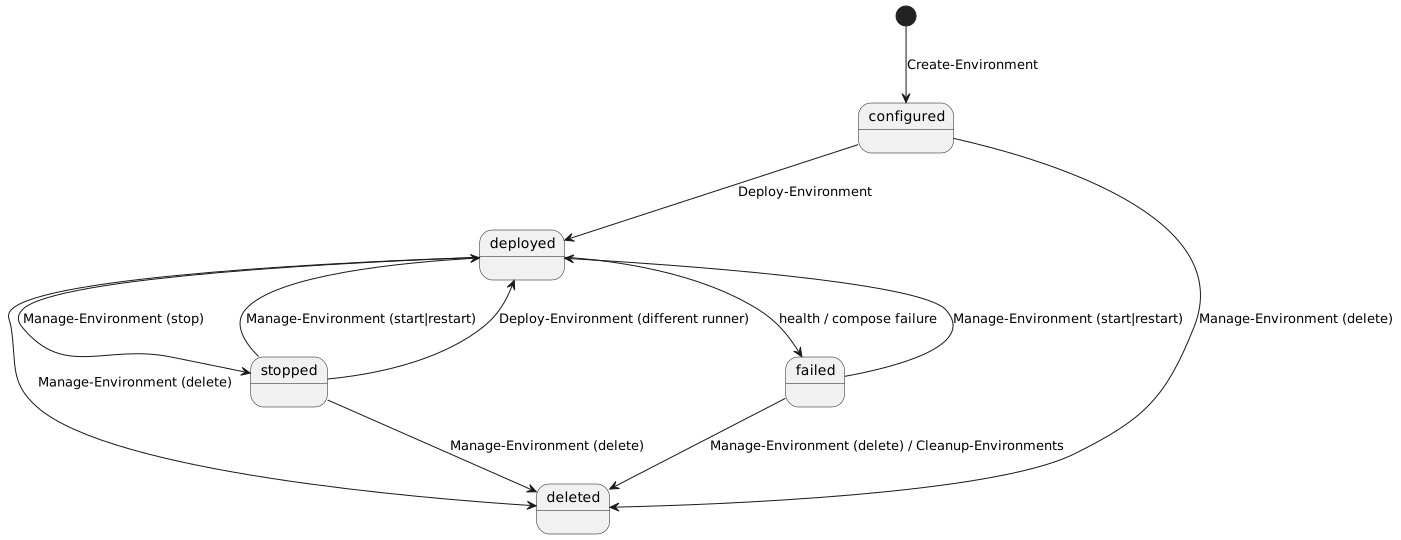
In v2.6.0 there are six user-facing Jenkins jobs under QA-Environments/: Create-Environment, Deploy-Environment, Update-Environment, Manage-Environment, List-Environments, and Cleanup-Environments. Everything that used to be a Stop-Environment, Delete-Environment, or Restore-Environment job is now an ACTION on Manage-Environment (see Usage).
configured, deployed, stopped, failed, and unknown are the allowed values — see QAConfig.Status. meta.status = 'unknown' is used as a defensive fallback when the meta file is malformed.
meta.json schema
Each env owns a meta.json under /var/jenkins_home/qa-data/envs/<env>/. Typical content:
{
  "env_name":       "andromeda-1745",
  "database_type":  "mysql",
  "services":       ["mysql", "hazelcast", "ftacs", "ui-backend"],
  "image_versions": { "ftacs": "5.12.3", "ui-backend": "latest" },
  "runner":         "qa-runner-04",
  "status":         "deployed",
  "ttl":            "1w",
  "created_at":     "2026-04-22T09:14:51Z",
  "created_by":     "alice",
  "owners":         ["bob", "carol"],
  "last_action":    "deploy",
  "last_action_at": "2026-04-22T09:17:02Z"
}| Field | Notes |
|---|---|
|
Must match |
|
|
|
Sorted list of enabled services. Must be a subset of the keys in |
|
Per-service tag map; omitted entries fall back to the template default ( |
|
Last agent the env was deployed on. Updated by |
|
One of |
|
One of |
|
Set once by |
|
Mutable list of Jenkins logins granted the same RBAC rights as the creator (except they can also be removed). See RBAC & Ownership. |
|
Written on every successful action for auditability. |
All writes to meta.json go through utils.atomicWriteMeta(path, data) — temp file + rename — to avoid torn reads if a second job reads the file mid-write.
Who drives which transition
| Job / step | Transition | Notes |
|---|---|---|
|
|
Renders compose + |
|
configured → deployed, stopped → deployed |
Runs port-conflict check, |
|
stays in current state |
Re-renders compose with new services / tags / vars. Strips Compose |
|
stopped or failed → deployed |
Thin wrapper over |
|
|
|
|
any → deleted |
|
|
no state change |
Rewrites |
|
stopped or failed → deployed |
Shared-library step reused by internal flows. End users reach the same outcome via Manage-Environment with ACTION=start (same runner) or Deploy-Environment (different runner). |
|
rewinds to a snapshot |
Uses |
|
expired → deleted |
TTL sweep, RBAC-aware (non-admins only see their own envs; cron passes see all). |
TTL and cleanup
cleanupEnvsStep is not scheduled by default — it must be triggered manually or wired to a cron trigger. When it runs it:
-
Lists envs the actor can see (RBAC filtered).
-
For each env with
ttl != 'infinity', computescreated_at + ttlagainstnow(). -
Calls the delete path for expired envs (with an optional grace window).
See Known Issues for the manual-trigger caveat.