Mesh
|
This module is currently unavailable and will be available in future versions. The documentation below is provided for reference only. |
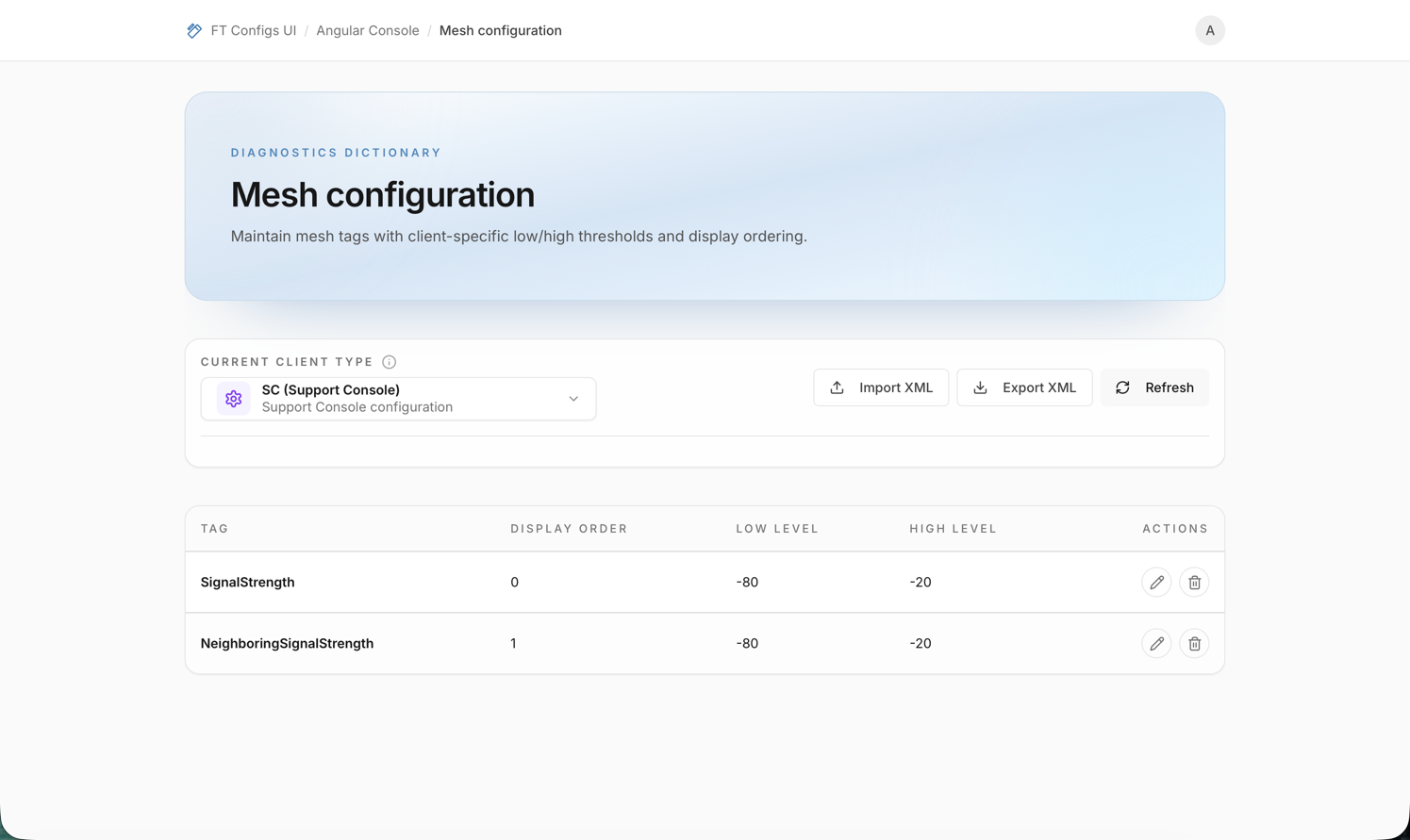
Mesh lets operators browse and maintain mesh-related configuration in the Angular Console. Because changes can affect device behavior and connectivity in production, always work in small steps and follow the safety flow (export → dry-run → import).
When to use this module
Use Mesh when you need to:
-
review existing configuration entries,
-
search/filter to find a specific entry,
-
export a snapshot as a backup before changes,
-
import bulk changes from a prepared file (with mandatory dry-run),
-
edit individual entries (if permitted),
-
verify what changed after an import or edit.
Prerequisites
-
Some deployments require selecting a Client Type before data loads.
-
Confirm your permissions:
-
VIEWER — browse and export.
-
EDITOR / ADMIN — edit and import.
-
-
If prerequisites are missing, the module may show an empty/guarded state and disable write actions.
Navigation path
-
Angular Console → Mesh
-
Before changing anything, verify the current context (environment, breadcrumbs, and Client Type if shown).
Common tasks
Browse and search
-
Open Mesh.
-
If the page provides filters or search, use them to narrow the list.
-
Open an entry to review its details.
What you should see:
-
a list/table of entries,
-
a details view (dialog/drawer/panel) with entry fields,
-
read-only state for VIEWER accounts.
Export a snapshot
-
Open Mesh.
-
Click Export (or the equivalent snapshot action).
-
Save the downloaded file as your backup.
For details, see: Export a Snapshot.
Import with dry-run (mandatory)
Import is the safest way to apply many changes at once. Always follow the workflow: export → dry-run → apply.
-
Export a snapshot first (recommended): Export a Snapshot.
-
Click Import (or the equivalent import action).
-
Select import mode if available (MERGE / REPLACE).
-
Upload the prepared file.
-
Wait for dry-run results to complete.
-
Review the plan (created / updated / deleted) and any warnings/errors.
-
Confirm the import only when the plan matches your intent.
Import safety checklist
-
Confirm you are in the correct environment.
-
Confirm your selected context (for example, client type) matches the file.
-
Export a snapshot before changes.
-
Run Dry-run and review:
-
errors (must be resolved),
-
warnings (understand impact),
-
create/update/delete counts.
-
-
If using REPLACE, confirm you accept deletions shown in the dry-run plan.
-
Apply import and immediately verify by refreshing and re-opening the affected entries.
| If REPLACE is available, it can delete entries that are not present in the imported file. Treat large delete counts as a stop signal until you confirm the file is complete and the context is correct. |
After-change verification checklist
-
Confirm you are in the intended environment.
-
Confirm the selected Client Type (if applicable).
-
Click Refresh (or re-open the module) to load the latest state.
-
Re-open changed entries and confirm values match your intent.
-
Spot-check a few unchanged entries to ensure no unintended changes.
-
If you imported, confirm the dry-run plan matches what actually changed.
-
(Optional) Export a new snapshot for audit: Export a Snapshot.
Troubleshooting
- No data shown
-
Confirm prerequisites (for example, required context/Client Type selection) and clear overly narrow filters/search queries.
- I can’t edit or import
-
You are likely signed in as VIEWER. Editing and import are available only for EDITOR or ADMIN.
- Dry-run shows errors
-
The file may not match the expected structure. Start from an export snapshot, apply your edits, and re-run dry-run.
- Dry-run shows many deletions
-
You may be using REPLACE (if available), or the file is incomplete for the current context. Re-check the selected context and regenerate the file from an export snapshot.
- Save is disabled or blocked
-
Fix validation errors shown in the UI, then try saving again.