System Architecture
- Overview
- High-Level Architecture
- Component Layers
- Deployment Architecture
- Network Architecture
- Storage Architecture
- Scaling Architecture
- Security Architecture
- Monitoring Architecture
- Disaster Recovery
- Related Documentation
This document describes the complete architecture of the FT Services platform, including deployment strategy, component interactions, and infrastructure design.
Overview
FT Services is a microservices-based telecommunications platform deployed on Kubernetes (K3s) using a GitOps approach with ArgoCD and Helm.
|
The architecture supports multiple database backends (MySQL and Oracle) through an abstraction layer, allowing seamless switching between environments. |
High-Level Architecture
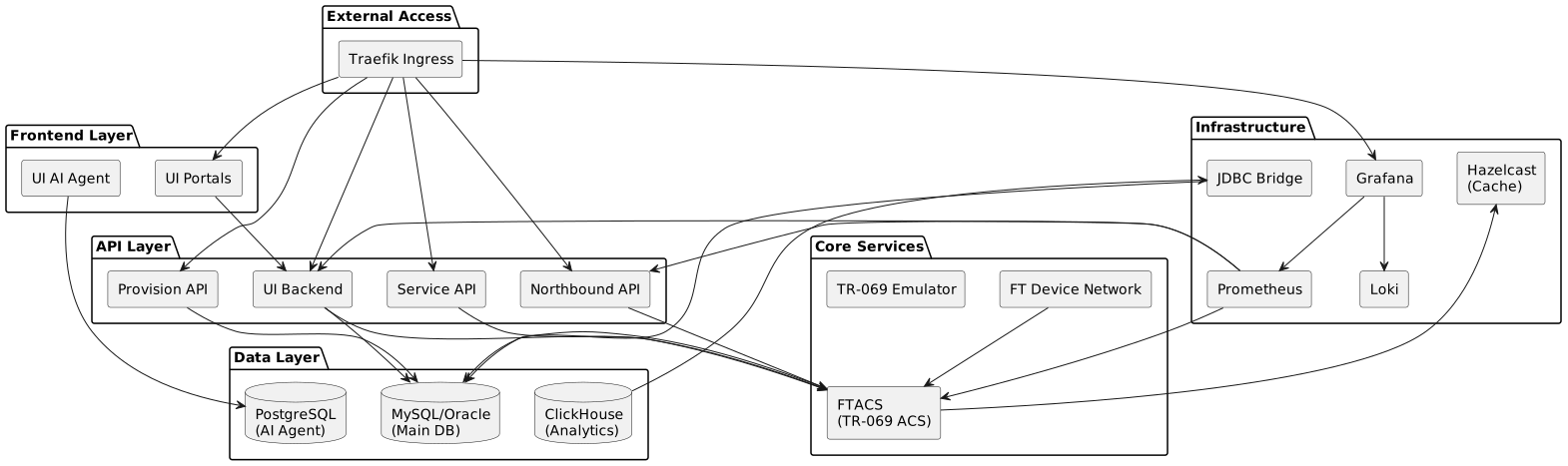
Component Layers
1. Ingress Layer
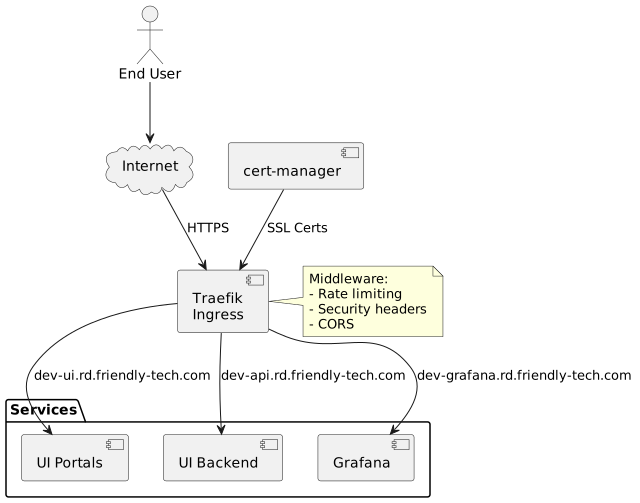
Component: Traefik IngressRoute
Responsibilities:
-
SSL/TLS termination
-
Request routing to services
-
Rate limiting and security headers
-
Load balancing
Configuration:
ingress:
  className: traefik
  hosts:
    ftacs: "${environment}.rd.friendly-tech.com"
    uiBackend: "${environment}-api.rd.friendly-tech.com"
    portals: "${environment}-ui.rd.friendly-tech.com"
2. Frontend Layer
UI Portals
-
Technology: Angular
-
Purpose: Web interface for end users
-
Ports: 80 (HTTP), 443 (HTTPS)
-
Dependencies: UI Backend
UI AI Agent
-
Technology: Python/FastAPI
-
Purpose: AI-powered assistance
-
Database: PostgreSQL
-
External API: Google Gemini
3. API Layer
UI Backend
-
Technology: Java/Spring Boot
-
Purpose: Main API gateway
-
Port: 8880
-
Dependencies: FTACS, Main DB
Northbound API
-
Technology: Java/Spring Boot
-
Purpose: External integration API
-
Port: 8082
-
Protocol: SOAP/REST
Service API
-
Technology: Java/Spring Boot
-
Purpose: Service management operations
-
Port: 8083
Provision API
-
Technology: Java/Spring Boot
-
Purpose: Provisioning portal
-
Port: 8084
-
Additional: Flowable workflow engine
4. Core Services
FTACS (TR-069 ACS Server)
-
Technology: Java/Spring
-
Purpose: TR-069 Auto Configuration Server
-
Port: 8080
-
Protocols: TR-069 (CWMP), USP
-
Critical Component: Yes
|
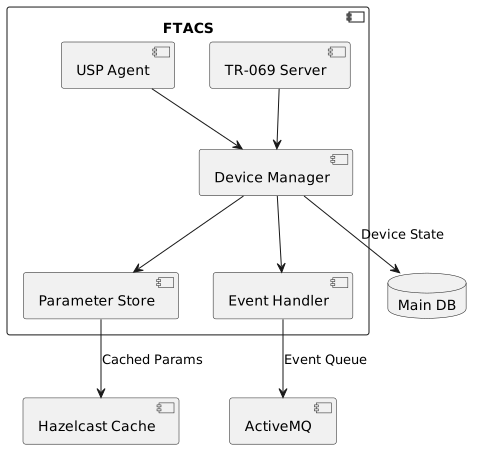
FTACS is the core service managing CPE devices. All other services depend on it. |
FT Device Network Service
-
Technology: Java/Spring Boot
-
Purpose: WiFi network management
-
Port: 8383
FT FCC Service
-
Technology: Java/Spring Boot 3.5.6, Java 25 (virtual threads)
-
Purpose: FCC Diagnostics — TR-143 speed/latency compliance testing
-
Port: 8080 (ClusterIP only)
-
Helm key:
ftFccService
|
FT FCC Service has no authentication of its own. It trusts the Be precise about what that buys, though: this chart ships no NetworkPolicy, so any pod in the cluster can reach |
Dependencies:
-
MySQL or Oracle — its own read-write schema
ftfcc, plus a read-only account on the ACS schemaftacs -
ClickHouse (the shared QoE database) — its own Flyway migration with history table
flyway_schema_history_fcc, deliberately distinct from the defaultflyway_schema_historythat FTACS, UI Backend and FT Device Network Service share on the same database -
Hazelcast (cluster name
dev) — the only channel to FTACS; FT FCC Service never calls FTACS directly
|
FT FCC Service splits its health probes: |
5. Data Layer
Main Database (MySQL/Oracle)
| Aspect | MySQL | Oracle |
|---|---|---|
Version |
8.4.6 |
XE 21 |
Usage |
Development |
Development & Production |
Storage |
10-20 GB |
20-50 GB |
Resources |
1-2 GB RAM |
2-8 GB RAM |
Schema |
Same across both |
Same across both |
Database Abstraction:
The platform uses Helm template helpers to abstract database selection:
{{- define "ft-services.dbJdbcUrl" -}}
{{- if eq .Values.database.type "mysql" -}}
jdbc:mysql://mysql:3306/{{ .Values.mysql.database }}
{{- else if eq .Values.database.type "oracle" -}}
jdbc:oracle:thin:@oracle:1521/{{ .Values.oracle.serviceName }}
{{- end -}}
{{- end }}
See ADR-001 for rationale.
PostgreSQL
-
Purpose: AI Agent data storage
-
Version: 16
-
Database:
ftl_ai -
Storage: 3 GB
ClickHouse
-
Purpose: Analytics and reporting
-
Version: 24.8
-
Storage: 20 GB
-
Access: Via JDBC Bridge
6. Infrastructure Services
Hazelcast
-
Purpose: Distributed caching
-
Version: 5.5.0
-
Mode: In-memory data grid
-
Replicas: 1 (dev), 3 (prod)
JDBC Bridge
-
Purpose: Connect ClickHouse to MySQL/Oracle
-
Technology: Custom JDBC connector
Prometheus
-
Purpose: Metrics collection
-
Scrape Interval: 30s
-
Retention: 15d
Grafana
-
Purpose: Metrics visualization
-
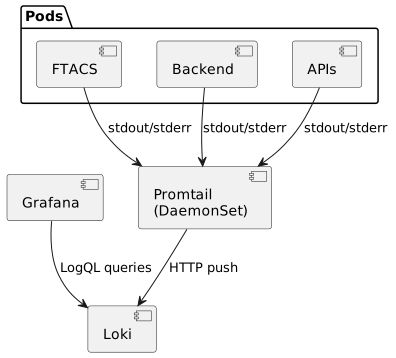
Data Sources: Prometheus, Loki
Loki
-
Purpose: Log aggregation
-
Retention: 7-30d (environment-dependent)
Deployment Architecture
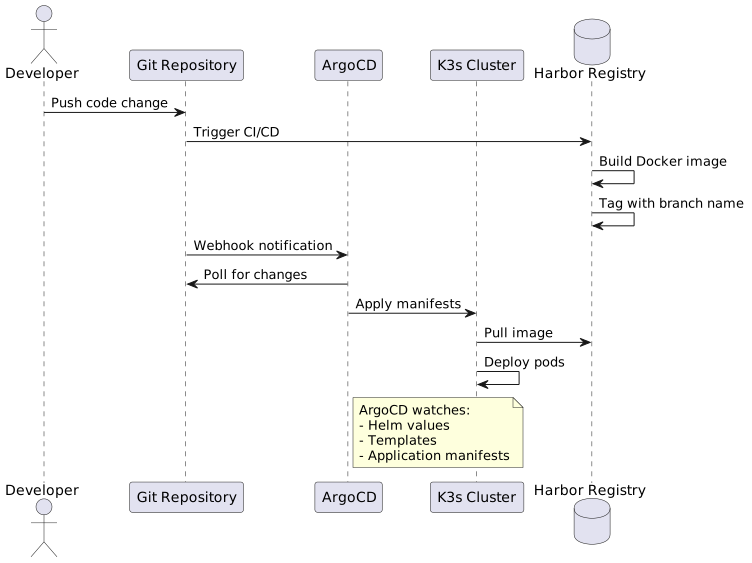
GitOps Flow
Environment Strategy
| Environment | Purpose | Namespace | ArgoCD App |
|---|---|---|---|
|
Daily development |
|
|
|
Oracle testing |
|
|
|
Feature branches |
|
Dynamic |
|
Production |
|
|
@startuml
skinparam backgroundColor transparent

package "Git Repository" {
    [values.yaml] as base
    [values-dev-mysql.yaml] as dev
    [values-dev-oracle.yaml] as oracle
    [values-main.yaml] as main
}

package "ArgoCD Applications" {
    [dev-mysql app] as devapp
    [dev-oracle app] as oracleapp
    [main app] as mainapp
}

package "K3s Cluster" {
    namespace "dev" {
        [Services] as devsvcs
        [MySQL] as devdb
    }

    namespace "dev-oracle" {
        [Services] as oraclesvcs
        [Oracle] as oracledb
    }

    namespace "production" {
        [Services] as mainsvcs
        [Oracle] as maindb
    }
}

base --> dev
base --> oracle
base --> main

dev --> devapp
oracle --> oracleapp
main --> mainapp

devapp --> devsvcs
devapp --> devdb

oracleapp --> oraclesvcs
oracleapp --> oracledb

mainapp --> mainsvcs
mainapp --> maindb

@enduml
Network Architecture
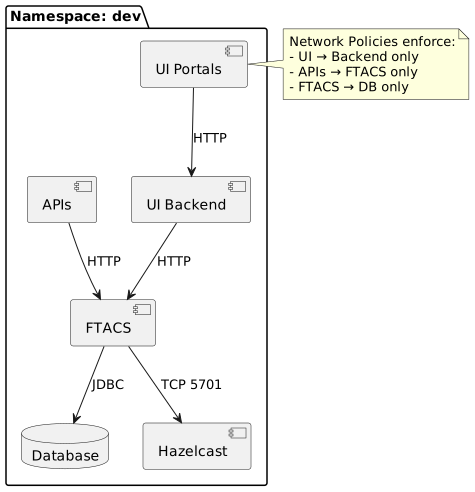
Service Communication
Network Policies
|
Network policies implement zero-trust networking with explicit allow rules. |
Key policies:
-
default-deny-all- Blocks all traffic by default -
allow-dns- Permits DNS resolution -
ftacs-policy- FTACS communication rules -
database-policy- Database access restrictions
External Access
Storage Architecture
Persistent Volumes
| Service | Purpose | Size | Type |
|---|---|---|---|
MySQL |
Database files |
10-20 GB |
RWO |
Oracle |
Database files |
20-50 GB |
RWO |
ClickHouse |
Analytics data |
20 GB |
RWO |
Hazelcast |
Persistent cache |
1 GB |
RWO |
Loki |
Log storage |
50 GB |
RWO |
Prometheus |
Metrics storage |
10 GB |
RWO |
MySQL Backups |
Database backups |
50 GB |
RWO |
Backup Strategy
| Component | Backup Method | Frequency | Retention |
|---|---|---|---|
MySQL |
mysqldump |
Daily 2 AM |
7 days |
Oracle |
RMAN |
Daily 2 AM |
14 days |
Persistent Volumes |
Velero snapshots |
Daily |
30 days |
Application State |
ArgoCD sync |
Continuous |
Git history |
Scaling Architecture
Horizontal Scaling
Services supporting HPA (Horizontal Pod Autoscaling):
-
UI Backend
-
Northbound API
-
Service API
-
Provision API
apiVersion: autoscaling/v2
kind: HorizontalPodAutoscaler
metadata:
  name: ui-backend
spec:
  scaleTargetRef:
    apiVersion: apps/v1
    kind: Deployment
    name: ui-backend
  minReplicas: 1
  maxReplicas: 10
  metrics:
  - type: Resource
    resource:
      name: cpu
      target:
        type: Utilization
        averageUtilization: 70
Vertical Scaling
Resource profiles defined per environment:
| Profile | CPU Request | Memory Request | Use Case |
|---|---|---|---|
small |
100m |
256Mi |
Feature branches |
medium |
500m |
1Gi |
Development |
large |
2000m |
4Gi |
Production |
Security Architecture
Authentication & Authorization
-
Ingress: Traefik with SSL/TLS termination
-
Services: Basic authentication or OAuth2 (configurable)
-
Database: Sealed Secrets for credentials
-
Registry: Harbor with role-based access
Secret Management

Network Security
-
Network Policies for pod-to-pod communication
-
Ingress rate limiting
-
Security headers (XSS, CSP, HSTS)
-
No exposed database ports externally
Monitoring Architecture
Metrics Collection
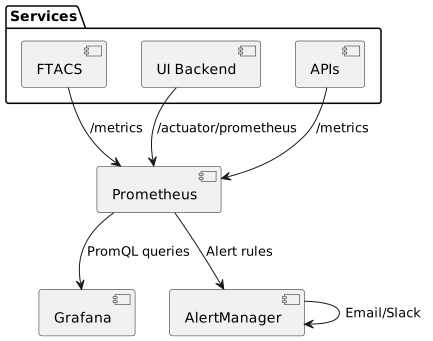
Key metrics:
-
Service availability
-
Response times (p50, p95, p99)
-
Error rates
-
Resource usage (CPU, memory)
-
Database query performance
Disaster Recovery
Key recovery points:
-
RTO (Recovery Time Objective): 4 hours
-
RPO (Recovery Point Objective): 1 hour
See Disaster Recovery Runbook for procedures.
Related Documentation
Last updated: 2026-10-14 19:00:09 +0200