Application testing
1. Overview
Testing in the Provision Portal project is structured to balance speed, reliability, and coverage. A combination of unit tests, integration tests, and process-level tests ensures confidence in business logic, service interaction, and external system integration.
Tests are organized by type and placed alongside the code they validate (typically in src/test/java).
Each test type serves a specific purpose:
-
Unit Tests: Fast and isolated. Ideal for verifying business logic and utility methods.
-
Integration Tests: Validate how components interact in a realistic Spring Boot context.
2. Best Practices
-
Follow naming conventions like
*Testor*ITto distinguish between unit and integration tests. -
Use
@MockBeanor Testcontainers to isolate dependencies in integration tests. -
Use
@ActiveProfiles("test")to activate test-specific configurations. -
Prefer readable assertions (
assertThat,assertEquals, etc.) over excessive mocking. -
Avoid external dependencies or shared state between tests unless explicitly required.
3. Coverage Goals
-
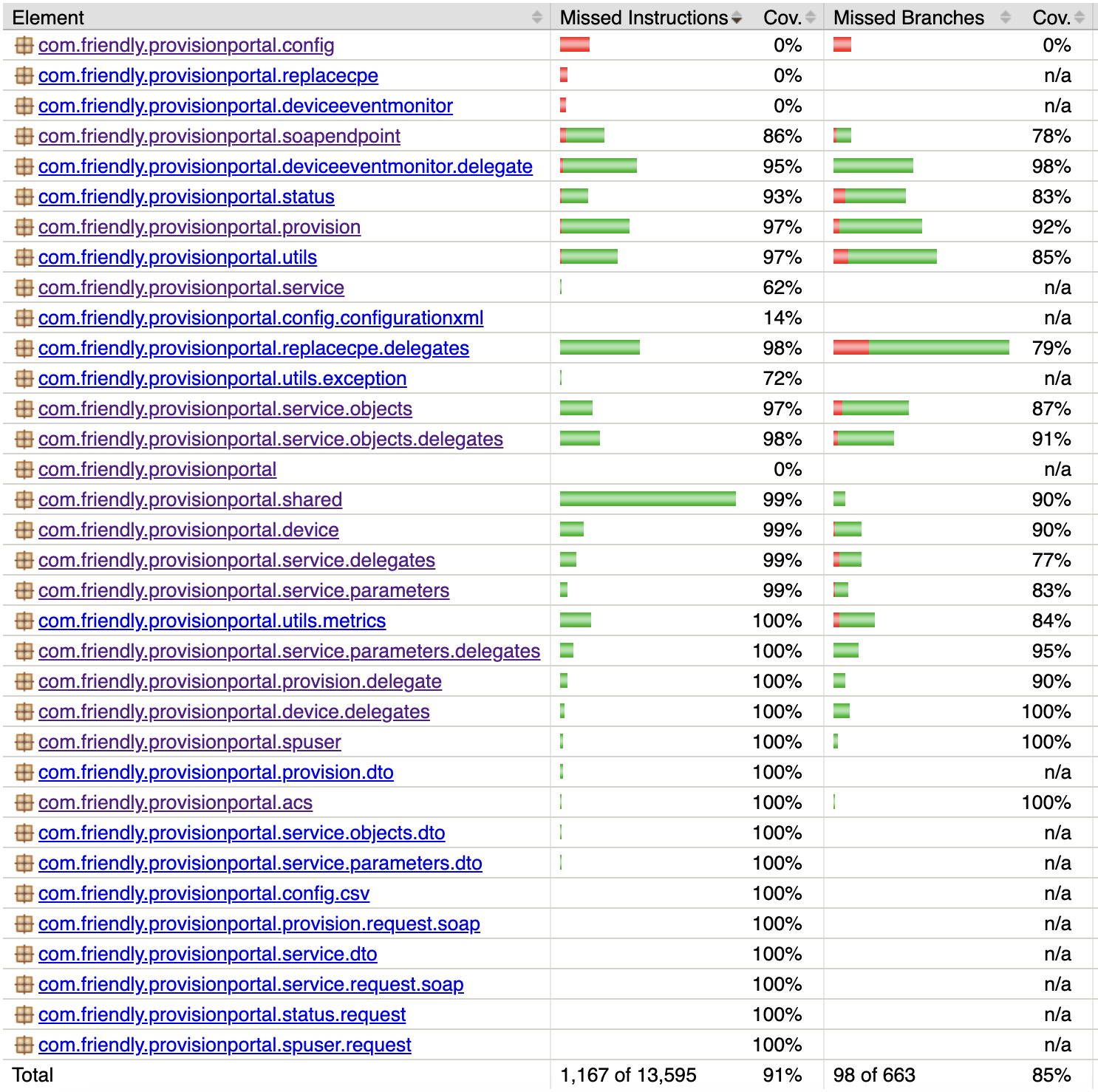
The project enforces a minimum of 80% code coverage via JaCoCo.
-
All new code should be accompanied by appropriate tests.
-
Focus on testing meaningful business logic, not just line coverage.
4. Unit Tests Example
-
Focus on individual components (e.g., service methods or delegates) in isolation.
-
Use
@ExtendWith(MockitoExtension.class)for mocking dependencies with Mockito. -
Example:
Unresolved include directive in modules/ROOT/pages/testing.adoc - include::../../src/test/java/com/friendly/provisionportal/provision/delegate/DeletePreviousByMacDelegateTest.java[]5. Integration Tests Example
-
Verify collaboration of components with full Spring Boot context.
-
Use
@SpringBootTest,@Sql, and@AutoConfigureMockMvc. -
Testcontainers spin up MySQL in isolation.
-
Example base class:
Unresolved include directive in modules/ROOT/pages/testing.adoc - include::../../src/test/java/com/friendly/provisionportal/BaseIT.java[]