Architecture
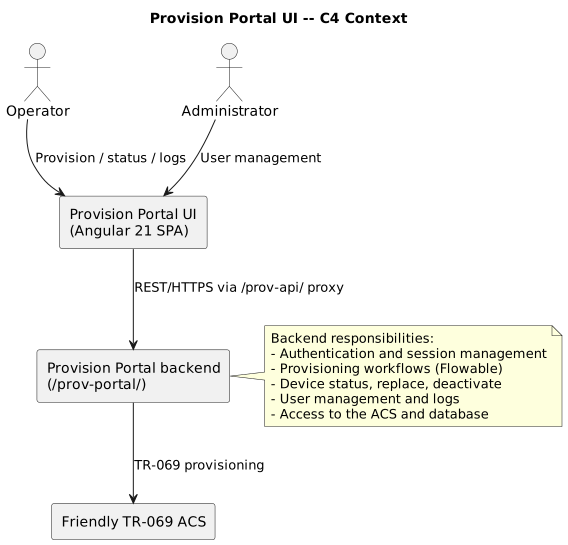
This document describes the runtime and logical architecture of the Provision Portal UI, its main building blocks, and how it interacts with the Provision Portal backend.
C4 Context
The container diagram shows how the browser, the single Nginx container, and the backend cooperate at runtime.
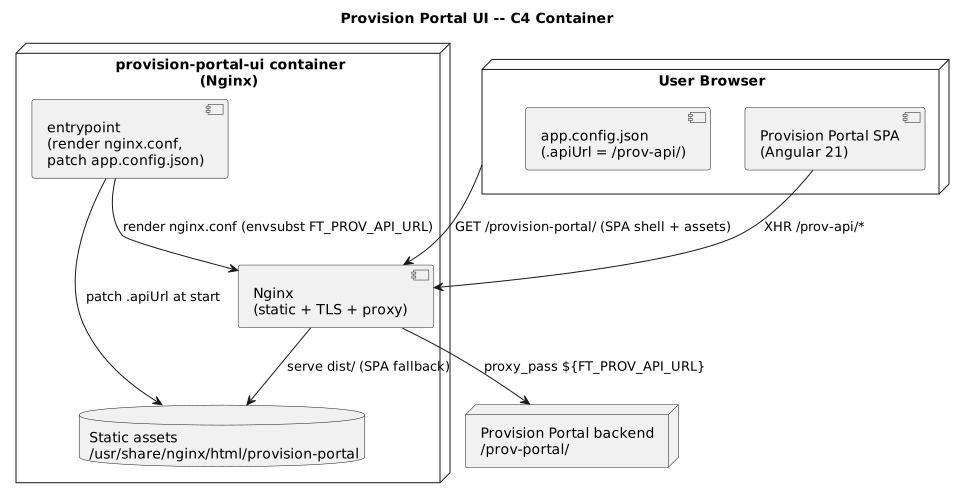
Note the difference from a browser-calls-backend-directly model: the browser always calls the
same-origin relative path /prov-api/, and Nginx reverse-proxies it to FT_PROV_API_URL. This keeps
the deployed artifact origin-agnostic and avoids browser CORS.
Workspace structure
The repository is a single-application Angular CLI 21 workspace. The src/app tree is organised by
role:
| Area | Role |
|---|---|
|
Route-level pages (single-device, multiple-device, replace-device, deactivate-service, get-status, view-log, user-management, login). |
|
Reusable, standalone form controls ( |
|
|
|
HTTP and state services ( |
|
|
|
|
|
Interfaces, enums, and the |
Client-side architecture
The Provision Portal UI is a standard Angular 21 application built from standalone components. Common building blocks:
-
HTTP layer. All services call a single
ApiService, which prefixes the runtimeapiUrl(/prov-api/) and JSON-serialises bodies. Two DI interceptors wrap every request. See API Integration. -
State management.
@ngrx/signalsSignal Store (UserStore) manages collection state; plain signal services (ServerService,MenuStateService) hold simple shared state. See State & Data Flow. -
Routing & layouts. Angular Router drives two layout shells (auth / main) with route guards. See Routing & Layouts.
-
i18n.
@ngx-translate/corewith the HTTP loader provides runtime translations fromassets/i18n/. -
UI toolkit. Angular Material / CDK,
ng-bootstrap+ Bootstrap 5,ngx-toastrfor notifications,angular-svg-iconfor inline SVGs.
Runtime configuration and API access
The application loads assets/config/app.config.json through an APP_INITIALIZER
(ConfigService.loadConfig()) before it boots, so apiUrl is available to the first HTTP call.
The container entrypoint patches that value to /prov-api/, and Nginx proxies /prov-api/ to the
backend — so the same image works across environments without a rebuild. See
Configuration and
API Integration.
| Architectural changes that affect authentication, routing, or runtime configuration should be reflected both in this document and in the C4 diagrams to keep them aligned. |