Mesh
|
This module is not available in the current version. It will be available in a future version. Use this page for reference only. |
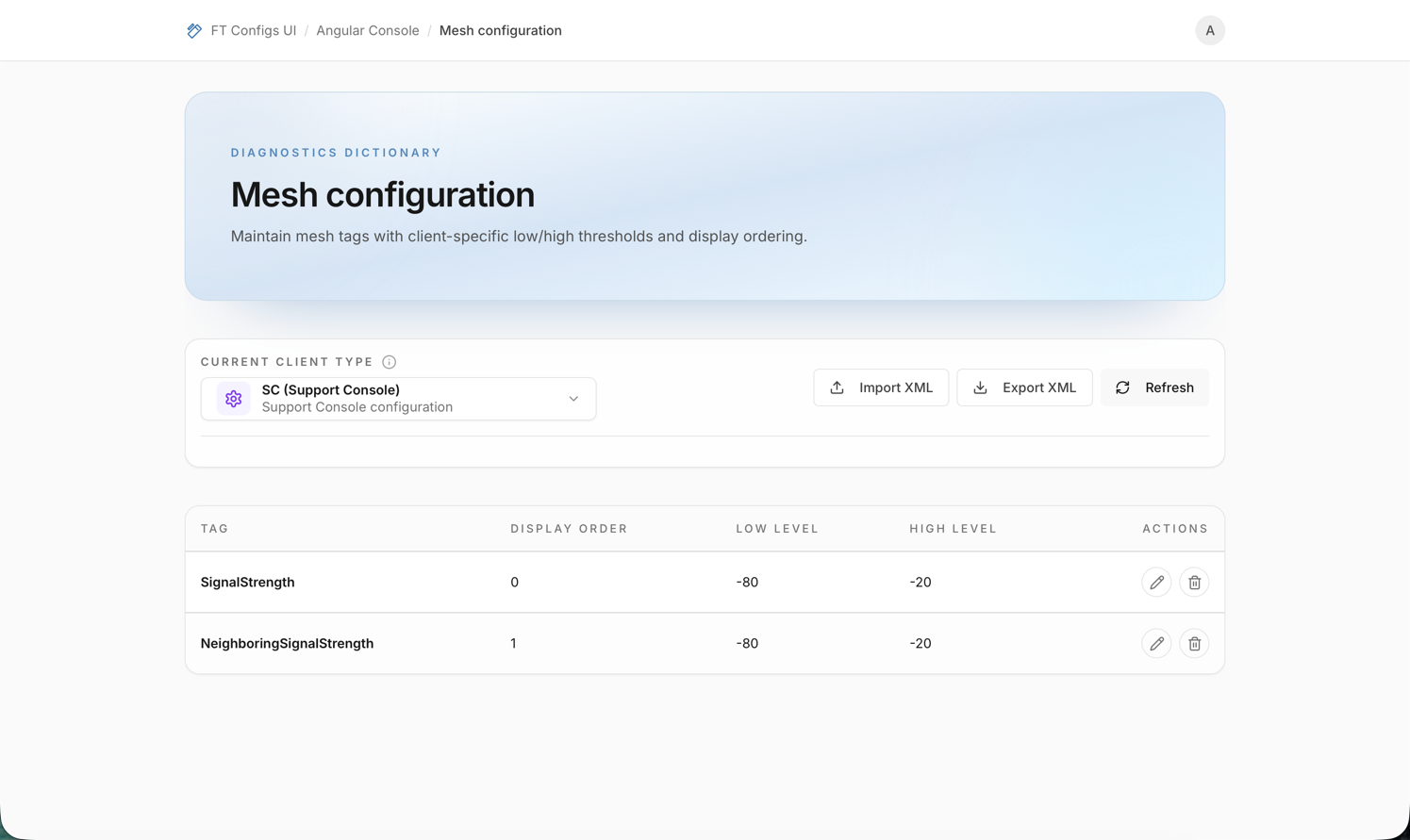
Mesh defines mesh signal tags for each client type. Each tag has a low threshold, a high threshold, and a display order.
Changes can affect device behavior and connectivity in production. Work in small steps and follow the safety flow: export, dry-run, import.
Where to find parameter descriptions: Open the create or edit dialog. The Tag name, Display order, Low level, and High level fields have a hint under the input.
When to use it
Use Mesh to do the following:
-
Review existing entries.
-
Search for an entry.
-
Export a snapshot as a backup before changes.
-
Import many changes from a prepared file. Dry-run is required.
-
Change single entries, if you have permission.
-
Check the result after an import or a change.
Before you start
-
Open Angular Console → Mesh.
-
If your deployment asks for it, select a Client type.
-
Check the context: environment, breadcrumbs, and client type if shown.
-
Check your role.
Roles for this module:
-
VIEWER: browse and export.
-
EDITOR or ADMIN: change entries and import.
If a requirement is missing, the module can show an empty state and disable write actions.
Find an entry
-
Open Mesh.
-
If the page has filters or search, use them to narrow the list.
-
Open an entry to read its details.
Expected result:
-
You see a list of entries.
-
You see a details view with the entry fields.
-
VIEWER accounts see a read-only view.
Export a snapshot
-
Open Mesh.
-
Click Export, or the similar snapshot action.
-
Save the downloaded file as your backup.
For details, see Export a Snapshot.
Import with dry-run
Import is the safest way to apply many changes at once. Always follow this order: export, dry-run, apply.
-
Export a snapshot first: Export a Snapshot.
-
Click Import, or the similar import action.
-
If the page shows an import mode, select MERGE or REPLACE.
-
Upload the prepared file.
-
Wait for the dry-run result.
-
Read the plan (created, updated, deleted) and all warnings and errors.
-
Confirm the import only if the plan matches your intent.
Import safety checklist
-
Check the environment name.
-
Check the selected client type. It must match the file.
-
Export a snapshot before you change data.
-
Run Dry-run and review:
-
the errors: you must fix them,
-
the warnings: you must understand them,
-
the create, update, and delete counts.
-
-
If you use REPLACE, review the deletions in the dry-run plan. Continue only if you accept them.
-
Apply the import.
-
Refresh the page and open the changed entries to check them.
| If REPLACE is available, it can delete entries missing from the imported file. If the plan shows many deletions, stop. Check if the file is complete and the context is correct. |
Change an entry
Required role: EDITOR or ADMIN.
-
Open the entry.
-
Click Edit.
-
Change the fields.
-
Click Save.
-
Refresh the page and open the entry again.
Expected result: the entry shows the saved values.
| Export a snapshot before large manual changes. You can then compare the result and restore the old state. |
Check the result
After a change or an import, do these steps:
-
Check if you are in the correct environment.
-
Check the selected Client type, if shown.
-
Click Refresh, or open the module again.
-
Open the changed entries and check the values.
-
Check a few unchanged entries. They must stay the same.
-
After an import, compare the dry-run plan with the real change.
-
Optional: export a new snapshot for audit. See Export a Snapshot.
Troubleshooting
- The page shows no data
-
A requirement can be missing, for example the client type. Check the requirements and clear narrow filters or search text.
- You cannot change or import
-
You are probably signed in as VIEWER. Only EDITOR and ADMIN can change entries and import.
- Dry-run shows errors
-
The file can have a wrong structure. Start from an exported snapshot, make your changes, and run the dry-run again.
- Dry-run shows many deletions
-
You can be using REPLACE, or the file is not complete for the current context. Check the selected context and create the file again from an exported snapshot.
- Save is disabled or blocked
-
The form shows validation errors. Fix the errors and save again.